The County
Beaches and Islands of the Coast
Long sand beaches, boat trips to the Farne Islands from Seahouses, the tide times of Holy Island and the villages between Alnmouth and Berwick.
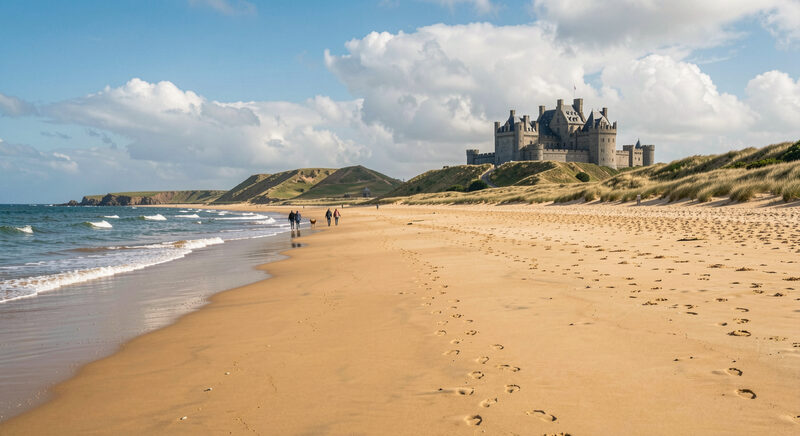
The Northumberland coast between Alnmouth and Berwick is an Area of Outstanding Natural Beauty that earns the designation quietly: long sand beaches backed by dunes, small fishing villages, castles at intervals along the skyline and two island destinations that run on nature's timetable rather than a ticket office's. From Alnwick, four miles inland, the whole coast is a day trip or a week of them.
The beaches
Beadnell Bay curves in a rare west facing arc, calm and shallow. Embleton Bay runs below the ruin of Dunstanburgh, which gives it the finest castle backdrop of any English beach. Bamburgh's sands sit beneath the great fortress on its rock. Further north, the beaches grow emptier still towards Berwick. All share the same character: firm sand, serious skies, room to breathe even in August, and water that rewards the brave rather than the casual swimmer. Dog walkers should note the county is broadly dog friendly, though seasonal restrictions apply on some stretches.
The Farne Islands
Off Seahouses lie the Farne Islands, an archipelago managed by the National Trust that hosts one of England's great seabird colonies: puffins in their tens of thousands in season, guillemots, razorbills, terns, and a large grey seal colony. Boats sail from Seahouses harbour, with landing trips on Inner Farne in season and non-landing cruises year round, weather permitting. Puffin season runs roughly May through July; the seals are resident. Trips are weather dependent, so flexibility in the itinerary pays.
Holy Island and its tide
Lindisfarne, Holy Island, is reached by a causeway that the North Sea covers twice daily. Safe crossing times are published and are not advisory: cars are caught every year by visitors who treat the tide as approximate. Check the published safe crossing times before setting out, and allow the margin the tables recommend. On the island, the ruined priory where the Lindisfarne Gospels began, the castle described in the castle guide, and the village all reward a stay within the tide's window rather than a rushed crossing.
Amble and the working harbour
Amble, at the mouth of the Coquet south of Warkworth, keeps a real working harbour alongside its visitor trade: the fish quay, boat trips of its own to Coquet Island and its seabirds, and the harbour village of independent pods that has grown into a small attraction in itself. It is the less polished, more lived-in counterpart to Seahouses and worth the extra ten minutes of driving for anyone who prefers a port to a resort.
The villages and stations
Alnmouth, where the Aln meets the sea, is the coast village nearest the town and holds the railway station that serves Alnwick: Newcastle under half an hour south, Edinburgh around an hour north. Craster, famous for kippers and as the start of the Dunstanburgh walk, and Seahouses, the boat harbour for the Farnes, fill out the working coast. Alnmouth's estuary and beach make it the simplest half day trip from town.
What about the gardens and houses near the shore?
The coast is not only sand. Howick Hall, a few miles inland from Craster, was the seat of Earl Grey, of tea fame, and its gardens and arboretum are among the county's finest, best in spring and early summer. Along the shore itself, the little harbours at Craster, Low Newton and Beadnell keep their lime kilns and boathouses, evidence that this holiday coast was a working one within living memory.
When is the best season for the coast?
May and June bring the seabirds at their peak and the long light; July and August bring the crowds that this coast's idea of crowds means, which is still emptiness by southern standards. September and October are the connoisseur's months: warm sea, quiet beaches, and the castles half empty. Winter is for the hardcore walker and the storm watcher, when the coast shows why the border country bred its temperament.
Druridge Bay, at the southern end of the protected coast, deserves a mention of its own: seven miles of sand and dunes where the coast path begins, quietest of all the main beaches and the easiest to reach from the southern approach to Alnwick. It suits the visitor who wants the coast without the castle backdrop.
Planning the coast days
Weather and tide rule this coast more than opening hours do. The practical order is to fix Holy Island around its crossing times first, choose a Farnes boat around the forecast second, and fill the remaining days with beaches and castle walks like those in the walks guide. After the coast, the town itself is close: everything inside Alnwick is a short drive or a short walk from the bed, chosen per the accommodation guide.