The Town
The History of Bondgate House
Three families in 150 years, a doctor's surgery, a fire insurance plaque and a street that changed its numbers: the documented story of an Alnwick townhouse.
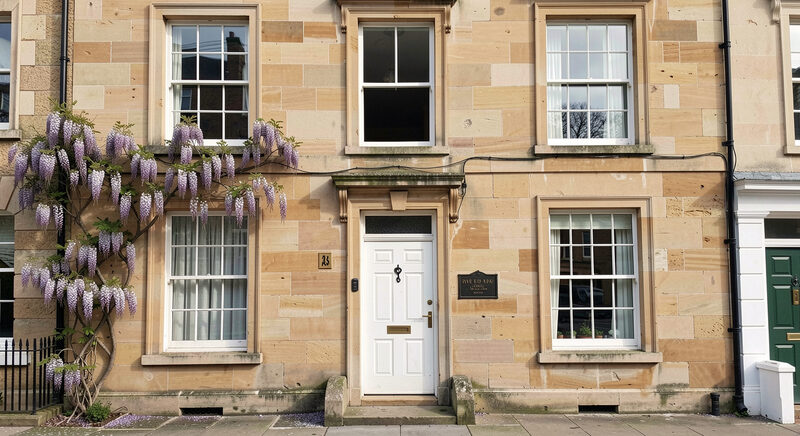
20 Bondgate Without is a three storey sandstone townhouse on the street that leads north out of Alnwick's market place towards the old town gate. For most of its recorded life it was a private house, then for much of the twentieth century a doctor's home and surgery, then a small hotel and finally a guest house whose owners began tracing its past. The research they started, continued by the Alnwick and District Local History Society, gives the house an unusually full biography.
Who lived in the house first?
The documentary trail begins with the Pringles. A Mr Pringle, an attorney in Alnwick, appears in trade directories around the 1820s and on an old fire station map against this house. He died in the 1840s, leaving his wife and two unmarried daughters in residence. Census records from 1841 onwards then track the house through the rest of the century.
The Robsons arrived towards the end of the nineteenth century. Robert Robson was one of Alnwick's doctors, and the house began its long association with medicine: after his death it was sold to another doctor, Bertie Trevor-Roper, who lived and practised here until the late 1970s. Between at least 1821 and 1978, only three families held the house: the Pringles, the Robsons and the Trevor-Ropers.
Who was the famous child of the house?
Bertie Trevor-Roper had three children, one of whom was Hugh Trevor-Roper, later Lord Dacre, the historian and one of the most combative historical writers of the twentieth century. The house on Bondgate Without was his childhood home. It was also among the first houses in Alnwick to have a telephone installed: its number was Alnwick 2, which raises the pleasant local question of who held Alnwick 1.
What do the walls themselves record?
The house's numbering wandered before it settled. It appears in records as 42 Bondgate Street, then 42 Bondgate Without, then 16 and 18 Bondgate Without before becoming number 20, a reminder that street numbering in small towns was redrawn through the nineteenth century. The building also grew: an additional storey was added in the late 1890s, raising it from two floors to three.
On the facade sits a small cast plaque, battered but legible: a fire insurance mark of the Newcastle Fire Office, established in 1783. The plaque probably dates from the 1840s according to the insurer's archivist. For most of the house's life it sat in the centre of a blocked first floor window; when that window was reopened in the late 1970s the mark was moved to the lintel above it, where it can still be read as the house's own badge of insurance against fire.
How was the history pieced together?
The house's biography was assembled the way small town history usually is: census returns from 1841 onward, trade directories listing the Pringles, a nineteenth century map kept in the local fire station, and the memory of the last family. The Alnwick and District Local History Society has since published its own account of the house, correcting and extending the earlier research, including the detail that the house was originally two storeys and gained its third floor in the late 1890s. It is a good example of how a single facade can be dated and read: blocked windows, a moved insurance plaque, renumbered doorways.
When did it stop being a family house?
After the Trevor-Roper years the house became a hotel, the only period when the name Bondgate House was formally its own. An earlier Bondgate House had been a draper's shop elsewhere in the street, established in 1798. As an hotel the building gained en-suite bedrooms and, in the 1990s, a cellar bar known as The Bondgate Cellar, reached by new front steps down to the basement, serving drinks and bar meals. Later still, the house settled into the bed and breakfast role its last custodians ran, with a four star gold award, while its coach house in the garden was converted to a self-catering cottage.
What remains visible from the street today?
The facade still tells the story to a passer-by who knows where to look: the raised third storey with its smaller windows, the insurance plaque above the door, the ground plan of a house built for one family rather than for guests. The walled garden behind, where the coach house stands, survives as the kind of space the street once needed for horses and carriages. Nothing on Bondgate Without announces the history; the interest is that it is all still there to be read.
The company behind the guest house was dissolved in 2016, and the house has returned to private life. Its biography, however, is on record: attorney's house, doctor's surgery, hotel, guest house, and the childhood home of a historian, all within one facade on a single Alnwick street. The street around it rewards the same attention, as the walk through Alnwick's lanes shows, and the castle that watched over all of it is covered in the castle and garden guide.