The Town
Alnwick Castle and The Alnwick Garden
A Norman seat of the Percy family and a contemporary garden with a famous Poison Garden: how the two big sights of Alnwick fit a day in town.
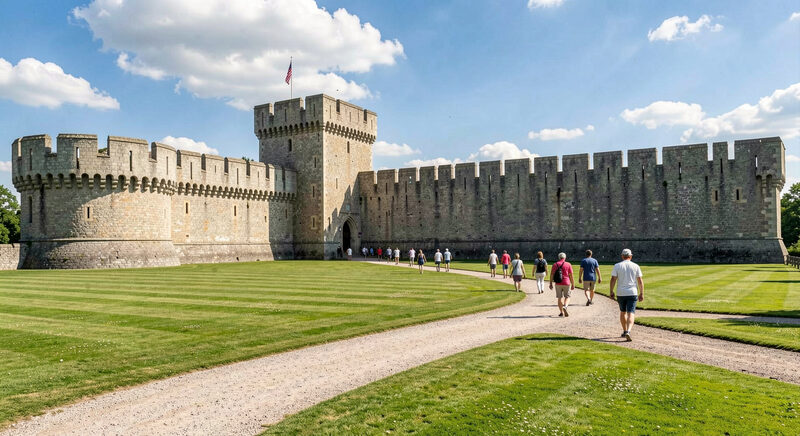
Alnwick's two headline sights face each other across a few hundred metres of parkland: the castle, a working Norman fortress still inhabited by the Percy family, and The Alnwick Garden, a contemporary garden created at the turn of this century. Together they are the reason most visitors come, and they are worth understanding as a pair: one a thousand years of accumulated power, the other a deliberately modern statement paid for by the same family.
What is Alnwick Castle?
The castle is the seat of the Duke of Northumberland and has belonged to the Percy family since 1309, though the fortress itself is older, its keep and curtain walls largely medieval. It remains a lived in house as well as a monument: the state rooms open to visitors hold one of the country's notable private art collections, and the family returns each winter. For many visitors the draw is cinematic: the castle's outer bailey and courtyards stood in for parts of Hogwarts in the first two Harry Potter films, and location spotting is openly embraced with themed tours and broomstick lessons on the lawn where the flying scenes were shot.
How much time does the castle take?
A thorough visit takes three to four hours: the state rooms, the keep and battlements, the museums within the walls covering the Percy tenantry and the castle's military history, and the grounds along the River Aln. The castle opens seasonally, broadly spring through autumn, and closes in winter when the family is in residence, so checking dates before a trip matters, especially outside the main season.
What is The Alnwick Garden?
The garden is a separate ticketed attraction beside the castle, opened in the early 2000s under the patronage of the Duchess of Northumberland. Its centrepiece is the Grand Cascade, a tumbling water staircase visible from the entrance, around which formal gardens, a rose garden, an ornamental garden and one of the world's largest wooden treehouses are arranged. The best known section is the Poison Garden, a fenced enclosure of genuinely toxic and narcotic plants, visitable only on guided tours and deliberately designed to educate rather than decorate.
How do the two fit a day in town?
The garden opens year round and works well in two to three hours, which makes the natural pairing castle in the morning, garden in the afternoon, or the reverse on a wet day since the garden wears rain better than the state rooms do crowds. Tickets are separate, and combination offers sometimes exist, worth checking on the official sites: the castle's own site and the garden's. Both sit within the town, so a visitor based in a guest house near the centre walks to both without touching the car.
What about the parkland and the riverside?
Between the castle walls and the garden runs the River Aln, and the pastures between them, crossed by public footpaths, give the classic free view of the castle: the great bailey profile from across the meadows, with the lion bridge at the estate edge. Visitors priced out of a full castle day, or passing through on a short stop, can still walk the riverside path and see what made this the Percy seat for seven centuries. It is also the gentlest walk in town, an easy hour that the walks guide sets beside the longer routes.
What do the two tickets cost in time rather than money?
Prices change, but the real budgeting is in hours. The castle rewards the longer visit; the garden rewards the slower one. Families often split: the castle's activity programme suits children who want broomsticks and dragons, while the garden's cascade and treehouse suit those who want space to run. Both have their own cafes, so the day needs no trip back into town for lunch, though the town's pubs are five minutes away for those who prefer them.
Are there events and seasonal closures to know?
Both run event programmes: the castle's medieval weekends, falconry and film-themed days, the garden's light trails and seasonal plantings. The castle closes in winter; the garden stays open but on reduced hours. Checking the current season on the official sites before a trip is the single most useful planning act.
What sits between them and the town?
Between the castle walls and the market place lie the streets where most visitors spend their evening: the shops and pubs of the centre, the lanes described in the lanes, bookshop and museum guide, and the history embedded in houses like Bondgate House. When the town is done, the county beyond it opens with its own castles, many of them wilder than this one.