The Town
Lanes, a Bookshop and a Museum
Pickwick Lane and Correction House Lane, a vast second-hand bookshop in the old railway station and a small town museum: the Alnwick between the big sights.
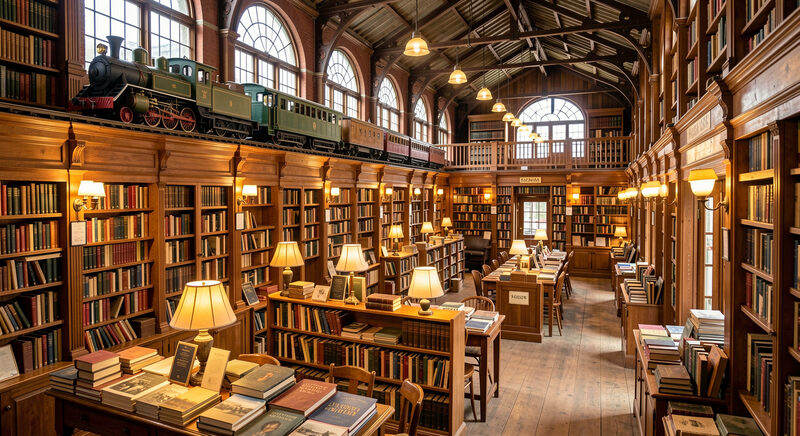
Between the castle and the garden, the part of Alnwick that costs nothing and rewards slowness is the town itself: a market place that has hosted markets for centuries, lanes with names that record older uses, a bookshop that has become a destination in its own right and a small museum that keeps the town's memory. An afternoon here needs no ticket, only time.
What is Barter Books and why do people cross the country for it?
Barter Books occupies Alnwick's Victorian railway station, closed to passengers in 1968 and converted into one of Britain's largest second-hand bookshops. The building does half the work: the old platform canopy, the station buffet room with its fires in winter, and a model railway running along tracks above the shelves. The stock runs to hundreds of thousands of volumes, and the shop's fame was sealed by a chance find: in a box of books bought at auction in 2000, the owners discovered an original 1939 Keep Calm and Carry On poster, one of the few surviving copies of a wartime poster never distributed. Its rediscovery here launched the design's global second life.
What do the lanes tell a walker?
Alnwick's lanes run between the main streets and carry their history in their names. Correction House Lane passes the site of the old house of correction. Pickwick Lane and the narrower passages off the market place are simply the medieval grain of the town. Bondgate itself splits at the tower: Bondgate Within inside the walls, Bondgate Without outside, a naming that encodes the town's defensive plan, and along which stands the townhouse whose story is told in the history of Bondgate House. The Bondgate Tower, also called Hotspur Tower, is the surviving fifteenth century gate through which the Great North Road once entered the town.
What is the Bailiffgate museum?
Bailiffgate Museum, in a former church close to the castle, is a volunteer-rich local museum covering the Alnwick district: archaeology, the town's trades, the Percy family's influence and the lives of ordinary residents across two centuries. It is small enough for an hour and specific enough to matter, the kind of museum where the volunteers have often lived the history they steward. Temporary exhibitions rotate through local themes, so repeat visits differ.
Is there still a working market?
The market place still works as a market place, with markets on regular days through the week and seasonal markets that swell the square. The square rewards a slow circuit: the market cross at its centre and the narrow entries between buildings that were once routes to stables and workshops. The streets around it carry more independent shops than a town this size usually supports, supplying the cottages and kitchens of self-catering visitors, a choice weighed in the B&B against cottage guide. The practical effect is that a week in Alnwick needs no supermarket trip and no car for the town days at all.
Eating and drinking in the centre
The lanes and the market place also carry the town's table: pubs that have served the market for centuries, cafes that fill at the bookshop's rhythm, and restaurants concentrated within a few streets. For a visitor on a hosted stay, the evening question is simply which of them to walk to; none requires the car. The density is the small town's advantage: the whole evening quarter sits inside a ten minute stroll.
What about Hulne Park at the town's edge?
At the top of the town, behind the castle, a gate leads into Hulne Park: the Duke's walled demesne, free to walkers in daylight hours, holding the ruins of a Carmelite priory founded in 1240. It is the point where the town walk becomes a country walk, covered among the longer routes in the walks guide.
What about the smaller details a walker notices?
The pleasure of these streets is in the marginalia: datestones on lintels, the change of stone from medieval rubble to Georgian ashlar between Bondgate Within and Bondgate Without, the coaching inn yards that still show their carriage entrances, the plaque marking the Bondgate townhouse's fire insurance mark. A walker who looks up between the shops reads two centuries of the town's building history without needing a museum case.
How do you sequence an afternoon in the centre?
The natural order is market place first, lanes second, bookshop last, since Barter Books absorbs whatever time remains. The museum fits between them for anyone who wants the context before the browsing, and the whole loop sits within the few streets that the town guide surveys.
When the lanes are walked, the wider county waits: the castles within a day, the coast and islands and the walking country are all short drives from these same streets.